Here Again the Rain Is Falling Put Under Closer

Mean precipitation based on global high resolution climate information (CHELSA)[1]
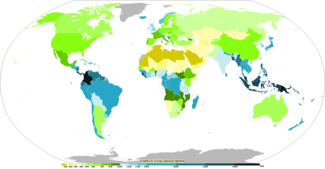
Countries by average annual atmospheric precipitation
In meteorology, atmospheric precipitation is any product of the condensation of atmospheric water vapor that falls under gravitational pull from clouds.[2] The chief forms of atmospheric precipitation include drizzling, rain, sleet, snow, ice pellets, graupel and hail. Precipitation occurs when a portion of the temper becomes saturated with water vapor (reaching 100% relative humidity), so that the h2o condenses and "precipitates" or falls. Thus, fog and mist are not precipitation only colloids, because the water vapor does non condense sufficiently to precipitate. Ii processes, possibly interim together, can lead to air becoming saturated: cooling the air or adding water vapor to the air. Precipitation forms as smaller aerosol coalesce via standoff with other rain drops or ice crystals within a cloud. Short, intense periods of rain in scattered locations are chosen showers.[iii]
Moisture that is lifted or otherwise forced to ascent over a layer of sub-freezing air at the surface may be condensed into clouds and rain. This process is typically agile when freezing rain occurs. A stationary front is often present near the area of freezing rain and serves every bit the focus for forcing and rising air. Provided there is necessary and sufficient atmospheric moisture content, the moisture within the ascension air will condense into clouds, namely nimbostratus and cumulonimbus if significant precipitation is involved. Eventually, the cloud droplets will abound large enough to form raindrops and descend toward the Earth where they volition freeze on contact with exposed objects. Where relatively warm h2o bodies are nowadays, for instance due to water evaporation from lakes, lake-effect snowfall becomes a business organization downwind of the warm lakes within the cold cyclonic flow around the behind of extratropical cyclones. Lake-upshot snowfall can exist locally heavy. Thundersnow is possible within a cyclone's comma head and inside lake event precipitation bands. In mountainous areas, heavy atmospheric precipitation is possible where upslope flow is maximized within windward sides of the terrain at tiptop. On the leeward side of mountains, desert climates tin be due to the dry air caused by compressional heating. Most atmospheric precipitation occurs inside the tropics[4] and is acquired past convection. The movement of the monsoon trough, or intertropical convergence zone, brings rainy seasons to savannah regions.
Precipitation is a major component of the water cycle, and is responsible for depositing fresh h2o on the planet. Approximately 505,000 cubic kilometres (121,000 cu mi) of water falls as atmospheric precipitation each year: 398,000 cubic kilometres (95,000 cu mi) over oceans and 107,000 cubic kilometres (26,000 cu mi) over land.[5] Given the Earth's surface area, that means the globally averaged almanac precipitation is 990 millimetres (39 in), just over land it is just 715 millimetres (28.one in). Climate classification systems such as the Köppen climate nomenclature system employ average annual rainfall to assist differentiate between differing climate regimes. Global warming is already causing changes to weather, increasing precipitation in some geographies, and reducing it in others, resulting in additional farthermost weather.[6]
Atmospheric precipitation may occur on other celestial bodies. Saturn's largest satellite, Titan, hosts methane precipitation as a slow-falling drizzle,[vii] which has been observed as Rain puddles at its equator[8] and polar regions.[9] [10]
History [edit]
The roots of precipitation date back to four.four billion years agone when the Earth existed in liquid water and was covered with water vapour and steam in the atmosphere. Then for millions of years, with the cooling of the planet, rain began to pour down, causing the planet to create puddles, lakes, and ultimately, permanent oceans.
During the period of the Water ice Age, with the rise of Human sapiens, much of Earth'southward climate repeatedly changed between very cold periods, when extensive water ice sheets and glaciers formed repeatedly on landmasses. Afterwards, they were receded and carved out into lakes, bays and rivers.
In Africa, during the Concluding Glacial Flow, there was an increment of rainfall when the overflow of Lake Albert and Lake Victoria, led to the formation of the Nile River, as well as the emergence of other rivers in Eurasia, including the Tigris and Euphrates in Mesopotamia, the Indus River and the Xanthous and Yangtze rivers, which would afterward accelerate the emergence of the outset civilizations.
In the reign of Sejong the Great, the Annals of the Joseon Dynasty recorded monitorings of atmospheric precipitation with the invention of the first rain gauge, known as the cheugugi.
Since antiquity, precipitation has remained a role of meteorology.
Types [edit]
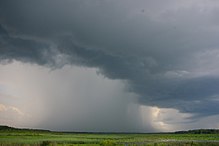
A thunderstorm with heavy precipitation
Precipitation is a major component of the h2o cycle, and is responsible for depositing most of the fresh water on the planet. Approximately 505,000 kmthree (121,000 mi3) of h2o falls as precipitation each yr, 398,000 km3 (95,000 cu mi) of information technology over the oceans.[v] Given the Earth'southward surface area, that means the globally averaged annual atmospheric precipitation is 990 millimetres (39 in).
Mechanisms of producing atmospheric precipitation include convective, stratiform,[11] and orographic rainfall.[12] Convective processes involve strong vertical motions that can cause the overturning of the atmosphere in that location within an 60 minutes and cause heavy atmospheric precipitation,[thirteen] while stratiform processes involve weaker upward motions and less intense precipitation.[14] Precipitation tin be divided into three categories, based on whether information technology falls every bit liquid water, liquid water that freezes on contact with the surface, or ice. Mixtures of different types of precipitation, including types in different categories, can fall simultaneously. Liquid forms of precipitation include pelting and drizzle. Rain or drizzle that freezes on contact within a subfreezing air mass is called "freezing rain" or "freezing drizzle". Frozen forms of precipitation include snow, ice needles, ice pellets, hail, and graupel.[15]
Measurement [edit]
- Liquid precipitation
- Rainfall (including drizzle and rain) is ordinarily measured using a rain judge and expressed in units of millimeters (mm) of tiptop or depth. Equivalently, information technology can be expressed equally a specific quantity of volume of h2o per collection area, in units of liters per square meter (L/grand2); as 1L=1dmiii=1mm·g2, the units of area (yardii) cancel out, resulting in simply "mm". This is besides equivalent to kg/kii, if bold that 1 liter of water has a mass of 1 kg (h2o density), which is acceptable for virtually practical purposes. The respective English language unit of measurement used is commonly inches. In Australia earlier metrication, rainfall was measured in "points" which were defined as a hundredth of an inch.[ citation needed ]
- Solid atmospheric precipitation
- A snowfall gauge is unremarkably used to mensurate the amount of solid atmospheric precipitation. Snowfall is usually measured in centimeters by letting snowfall fall into a container and then measure the height. The snow can then optionally be melted to obtain a h2o equivalent measurement in millimeters like for liquid precipitation. The relationship between snowfall summit and water equivalent depends on the water content of the snowfall; the water equivalent can thus only provide a rough estimate of snow depth. Other forms of solid precipitation, such as snowfall pellets and hail or even sleet (pelting and snowfall mixed), tin can besides be melted and measured as water equivalent, unremarkably expressed millimeters like for liquid precipitation.[ citation needed ]
How the air becomes saturated [edit]
Cooling air to its dew point [edit]
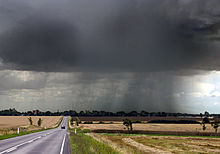
Late-summer rainstorm in Kingdom of denmark

Lenticular cloud forming due to mountains over Wyoming
The dew point is the temperature to which a parcel of air must exist cooled in guild to become saturated, and (unless super-saturation occurs) condenses to water.[sixteen] Water vapor normally begins to condense on condensation nuclei such equally dust, ice, and salt in order to form clouds. The deject condensation nuclei concentration will make up one's mind the cloud microphysics.[17] An elevated portion of a frontal zone forces broad areas of lift, which form cloud decks such equally altostratus or cirrostratus. Stratus is a stable cloud deck which tends to form when a cool, stable air mass is trapped underneath a warm air mass. It tin can also grade due to the lifting of advection fog during breezy conditions.[18]
There are four main mechanisms for cooling the air to its dew point: adiabatic cooling, conductive cooling, radiational cooling, and evaporative cooling. Adiabatic cooling occurs when air rises and expands.[nineteen] The air tin can rise due to convection, large-calibration atmospheric motions, or a physical barrier such as a mountain (orographic elevator). Conductive cooling occurs when the air comes into contact with a colder surface,[20] usually by being blown from one surface to another, for instance from a liquid water surface to colder country. Radiational cooling occurs due to the emission of infrared radiation, either by the air or by the surface underneath.[21] Evaporative cooling occurs when wet is added to the air through evaporation, which forces the air temperature to cool to its wet-bulb temperature, or until it reaches saturation.[22]
Adding wet to the air [edit]
The primary means h2o vapor is added to the air are: wind convergence into areas of upward movement,[13] precipitation or virga falling from above,[23] daytime heating evaporating h2o from the surface of oceans, water bodies or wet land,[24] transpiration from plants,[25] absurd or dry air moving over warmer water,[26] and lifting air over mountains.[27]
Forms of precipitation [edit]

Condensation and coalescence are important parts of the water cycle.
Raindrops [edit]
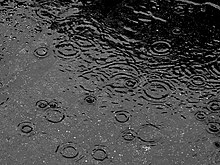
Coalescence occurs when water droplets fuse to create larger water droplets, or when h2o droplets freeze onto an ice crystal, which is known as the Bergeron process. The fall rate of very pocket-size droplets is negligible, hence clouds do not fall out of the sky; atmospheric precipitation volition but occur when these coagulate into larger drops. droplets with different size will take different terminal velocity that cause aerosol collision and producing larger droplets, Turbulence will enhance the collision procedure.[28] Every bit these larger water droplets descend, coalescence continues, and then that drops become heavy enough to overcome air resistance and fall equally rain.[29]
Raindrops have sizes ranging from 5.1 millimetres (0.20 in) to 20 millimetres (0.79 in) hateful diameter, higher up which they tend to break upward. Smaller drops are called cloud aerosol, and their shape is spherical. As a raindrop increases in size, its shape becomes more oblate, with its largest cross-section facing the oncoming airflow. Contrary to the drawing pictures of raindrops, their shape does non resemble a teardrop.[30] Intensity and duration of rainfall are usually inversely related, i.e., high intensity storms are probable to be of brusque duration and low intensity storms can take a long duration.[31] [32] Rain drops associated with melting hail tend to exist larger than other rain drops.[33] The METAR lawmaking for rain is RA, while the coding for rain showers is SHRA.[34]
Ice pellets [edit]
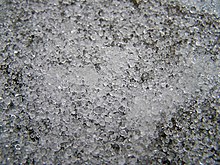
An accumulation of water ice pellets
Ice pellets or sleet are a class of precipitation consisting of small, translucent balls of ice. Ice pellets are ordinarily (but not ever) smaller than hailstones.[35] They often bounce when they hit the ground, and generally do non freeze into a solid mass unless mixed with freezing rain. The METAR code for ice pellets is PL.[34]
Ice pellets course when a layer of above-freezing air exists with sub-freezing air both above and beneath. This causes the partial or complete melting of any snowflakes falling through the warm layer. Equally they autumn back into the sub-freezing layer closer to the surface, they re-freeze into ice pellets. Yet, if the sub-freezing layer below the warm layer is besides small, the precipitation volition non have time to re-freeze, and freezing rain will exist the result at the surface. A temperature profile showing a warm layer above the ground is near likely to be plant in advance of a warm front during the common cold season,[36] but can occasionally be plant behind a passing cold front.
Hail [edit]
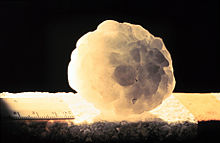
A large hailstone, about 6 centimetres (ii.4 in) in diameter
Like other precipitation, hail forms in storm clouds when supercooled water droplets freeze on contact with condensation nuclei, such equally grit or clay. The storm's updraft blows the hailstones to the upper role of the cloud. The updraft dissipates and the hailstones fall down, back into the updraft, and are lifted again. Hail has a diameter of 5 millimetres (0.twenty in) or more.[37] Within METAR code, GR is used to bespeak larger hail, of a diameter of at least 6.four millimetres (0.25 in). GR is derived from the French word grêle. Smaller-sized hail, as well as snow pellets, utilise the coding of GS, which is short for the French word grésil.[34] Stones only larger than golf ball-sized are 1 of the almost frequently reported hail sizes.[38] Hailstones can abound to fifteen centimetres (6 in) and weigh more 500 grams (1 lb).[39] In large hailstones, latent heat released by further freezing may cook the outer shell of the hailstone. The hailstone so may undergo 'moisture growth', where the liquid outer shell collects other smaller hailstones.[40] The hailstone gains an ice layer and grows increasingly larger with each ascent. Once a hailstone becomes too heavy to be supported by the storm's updraft, it falls from the cloud.[41]
Snowflakes [edit]

Snowflake viewed in an optical microscope
Snow crystals form when tiny supercooled cloud droplets (about ten μm in diameter) freeze. Once a droplet has frozen, information technology grows in the supersaturated environment. Because water droplets are more numerous than the water ice crystals the crystals are able to abound to hundreds of micrometers in size at the expense of the h2o droplets. This procedure is known as the Wegener–Bergeron–Findeisen procedure. The corresponding depletion of water vapor causes the droplets to evaporate, meaning that the ice crystals abound at the droplets' expense. These big crystals are an efficient source of atmospheric precipitation, since they fall through the atmosphere due to their mass, and may collide and stick together in clusters, or aggregates. These aggregates are snowflakes, and are usually the type of ice particle that falls to the ground.[42] Guinness World Records list the world's largest snowflakes equally those of January 1887 at Fort Keogh, Montana; allegedly one measured 38 cm (15 inches) wide.[43] The exact details of the sticking machinery remain a subject of research.
Although the water ice is clear, scattering of calorie-free by the crystal facets and hollows/imperfections mean that the crystals oftentimes announced white in color due to diffuse reflection of the whole spectrum of light by the pocket-sized ice particles.[44] The shape of the snowflake is determined broadly past the temperature and humidity at which it is formed.[42] Rarely, at a temperature of around −2 °C (28 °F), snowflakes can class in threefold symmetry—triangular snowflakes.[45] The near common snow particles are visibly irregular, although most-perfect snowflakes may be more than common in pictures because they are more visually appealing. No ii snowflakes are akin,[46] equally they grow at dissimilar rates and in different patterns depending on the changing temperature and humidity inside the atmosphere through which they autumn on their manner to the ground.[47] The METAR code for snow is SN, while snowfall showers are coded SHSN.[34]
Diamond grit [edit]
Diamond dust, as well known as ice needles or water ice crystals, forms at temperatures approaching −40 °C (−40 °F) due to air with slightly college moisture from aloft mixing with colder, surface-based air.[48] They are made of elementary ice crystals, hexagonal in shape.[49] The METAR identifier for diamond dust within international hourly atmospheric condition reports is IC.[34]
Occult deposition [edit]
Occult deposition occurs when mist or air that is highly saturated with h2o vapour interacts with the leaves of trees or shrubs information technology passes over.[50]
Causes [edit]
Frontal activity [edit]
Stratiform or dynamic precipitation occurs as a upshot of slow ascent of air in synoptic systems (on the order of cm/southward), such as over surface common cold fronts, and over and ahead of warm fronts. Similar rise is seen around tropical cyclones outside of the eyewall, and in comma-head atmospheric precipitation patterns around mid-latitude cyclones.[51] A broad variety of atmospheric condition can be found along an occluded front, with thunderstorms possible, merely usually their passage is associated with a drying of the air mass. Occluded fronts usually form around mature low-pressure areas.[52] Precipitation may occur on celestial bodies other than World. When it gets cold, Mars has precipitation that most likely takes the form of ice needles, rather than rain or snow.[53]
Convection [edit]
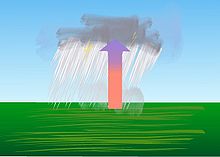
Convective rain, or showery precipitation, occurs from convective clouds, e.one thousand. cumulonimbus or cumulus congestus. Information technology falls every bit showers with apace changing intensity. Convective atmospheric precipitation falls over a certain surface area for a relatively curt fourth dimension, equally convective clouds have limited horizontal extent. Near precipitation in the torrid zone appears to be convective; all the same, it has been suggested that stratiform atmospheric precipitation also occurs.[32] [51] Graupel and hail bespeak convection.[54] In mid-latitudes, convective precipitation is intermittent and often associated with baroclinic boundaries such equally common cold fronts, squall lines, and warm fronts.[55]
Orographic effects [edit]
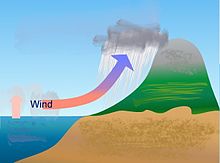
Orographic precipitation occurs on the windward (upwind) side of mountains and is acquired by the rising air move of a large-calibration flow of moist air across the mountain ridge, resulting in adiabatic cooling and condensation. In mountainous parts of the world subjected to relatively consequent winds (for example, the trade winds), a more moist climate usually prevails on the windward side of a mountain than on the leeward or downwind side. Moisture is removed past orographic lift, leaving drier air (see katabatic current of air) on the descending and by and large warming, leeward side where a rain shadow is observed.[27]
In Hawaii, Mount Waiʻaleʻale, on the island of Kauai, is notable for its extreme rainfall, as it has the 2d-highest average annual rainfall on Earth, with 12,000 millimetres (460 in).[56] Storm systems bear on the state with heavy rains between October and March. Local climates vary considerably on each island due to their topography, divisible into windward (Koʻolau) and leeward (Kona) regions based upon location relative to the higher mountains. Windward sides face the east to northeast trade winds and receive much more than rainfall; leeward sides are drier and sunnier, with less rain and less cloud cover.[57]
In Southward America, the Andes mountain range blocks Pacific moisture that arrives in that continent, resulting in a desertlike climate just downwind beyond western Argentina.[58] The Sierra Nevada range creates the aforementioned result in North America forming the Smashing Basin and Mojave Deserts.[59] [lx] Similarly, in Asia, the Himalaya mountains create an obstacle to monsoons which leads to extremely loftier precipitation on the southern side and lower precipitation levels on the northern side.
Snow [edit]

Lake-effect snow bands about the Korean Peninsula in early Dec 2008
Extratropical cyclones tin can bring common cold and dangerous conditions with heavy rain and snow with winds exceeding 119 km/h (74 mph),[61] (sometimes referred to equally windstorms in Europe). The band of precipitation that is associated with their warm forepart is often extensive, forced past weak upward vertical motion of air over the frontal boundary which condenses as it cools and produces precipitation within an elongated ring,[62] which is wide and stratiform, meaning falling out of nimbostratus clouds.[63] When moist air tries to dislodge an arctic air mass, overrunning snowfall can consequence within the poleward side of the elongated precipitation band. In the Northern Hemisphere, poleward is towards the North Pole, or n. Within the Southern Hemisphere, poleward is towards the Due south Pole, or southward.
Southwest of extratropical cyclones, curved cyclonic flow bringing cold air beyond the relatively warm water bodies tin can lead to narrow lake-outcome snow bands. Those bands bring strong localized snowfall which can exist understood as follows: Big water bodies such every bit lakes efficiently shop heat that results in meaning temperature differences (larger than 13 °C or 23 °F) between the water surface and the air above.[64] Because of this temperature difference, warmth and wet are transported upward, condensing into vertically oriented clouds (see satellite film) which produce snowfall showers. The temperature decrease with summit and cloud depth are directly affected by both the water temperature and the big-scale environs. The stronger the temperature subtract with height, the deeper the clouds get, and the greater the precipitation charge per unit becomes.[65]
In mountainous areas, heavy snowfall accumulates when air is forced to ascend the mountains and clasp out precipitation along their windward slopes, which in common cold conditions, falls in the form of snow. Because of the ruggedness of terrain, forecasting the location of heavy snowfall remains a significant challenge.[66]
Inside the tropics [edit]

Rainfall distribution by month in Cairns showing the extent of the wet flavor at that location
The moisture, or rainy, season is the time of year, roofing one or more months, when most of the boilerplate annual rainfall in a region falls.[67] The term green season is also sometimes used as a euphemism by tourist authorities.[68] Areas with wet seasons are dispersed beyond portions of the tropics and subtropics.[69] Savanna climates and areas with monsoon regimes have wet summers and dry winters. Tropical rainforests technically do not have dry or wet seasons, since their rainfall is equally distributed through the year.[70] Some areas with pronounced rainy seasons will see a intermission in rainfall mid-season when the intertropical convergence zone or monsoon trough move poleward of their location during the eye of the warm flavour.[31] When the wet season occurs during the warm flavour, or summer, rain falls mainly during the tardily afternoon and early evening hours. The wet season is a time when air quality improves,[71] freshwater quality improves,[72] [73] and vegetation grows significantly. Soil nutrients diminish and erosion increases.[31] Animals have adaptation and survival strategies for the wetter regime. The previous dry season leads to food shortages into the wet flavor, as the crops take yet to mature. Developing countries have noted that their populations show seasonal weight fluctuations due to food shortages seen before the first harvest, which occurs late in the moisture season.[74]
Tropical cyclones, a source of very heavy rainfall, consist of big air masses several hundred miles across with low pressure at the centre and with winds bravado inwards towards the centre in either a clockwise direction (southern hemisphere) or counterclockwise (northern hemisphere).[75] Although cyclones can have an enormous toll in lives and personal belongings, they may be important factors in the precipitation regimes of places they impact, as they may bring much-needed atmospheric precipitation to otherwise dry regions.[76] Areas in their path tin receive a year'due south worth of rainfall from a tropical cyclone passage.[77]
Big-scale geographical distribution [edit]
On the large calibration, the highest atmospheric precipitation amounts exterior topography fall in the tropics, closely tied to the Intertropical Convergence Zone, itself the ascending branch of the Hadley cell. Mountainous locales virtually the equator in Colombia are amidst the wettest places on Earth.[78] N and due south of this are regions of descending air that grade subtropical ridges where precipitation is low;[79] the land surface underneath these ridges is usually barren, and these regions make upward most of the Earth'south deserts.[80] An exception to this rule is in Hawaii, where upslope period due to the trade winds pb to i of the wettest locations on Earth.[81] Otherwise, the menstruum of the Westerlies into the Rocky Mountains atomic number 82 to the wettest, and at elevation snowiest,[82] locations within Northward America. In Asia during the wet season, the flow of moist air into the Himalayas leads to some of the greatest rainfall amounts measured on Earth in northeast India.
Measurement [edit]
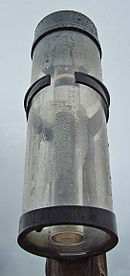
The standard way of measuring rainfall or snowfall is the standard rain gauge, which can be found in 100 mm (4 in) plastic and 200 mm (eight in) metal varieties.[83] The inner cylinder is filled by 25 mm (1 in) of rain, with overflow flowing into the outer cylinder. Plastic gauges have markings on the inner cylinder down to 0.25 mm (0.01 in) resolution, while metal gauges crave use of a stick designed with the appropriate 0.25 mm (0.01 in) markings. Later the inner cylinder is filled, the corporeality inside is discarded, and then filled with the remaining rainfall in the outer cylinder until all the fluid in the outer cylinder is gone, calculation to the overall total until the outer cylinder is empty. These gauges are used in the winter by removing the funnel and inner cylinder and assuasive snowfall and freezing rain to collect inside the outer cylinder. Some add together anti-freeze to their gauge so they do non have to cook the snow or ice that falls into the gauge.[84] Once the snowfall/ice is finished accumulating, or as 300 mm (12 in) is approached, one can either bring it inside to cook, or employ lukewarm h2o to fill up the inner cylinder with in order to cook the frozen precipitation in the outer cylinder, keeping track of the warm fluid added, which is afterwards subtracted from the overall total once all the ice/snowfall is melted.[85]
Other types of gauges include the popular wedge estimate (the cheapest pelting guess and most frail), the tipping bucket pelting estimate, and the weighing rain gauge.[86] The wedge and tipping bucket gauges have problems with snow. Attempts to compensate for snow/ice by warming the tipping bucket meet with limited success, since snowfall may sublimate if the approximate is kept much higher up freezing. Weighing gauges with antifreeze should do fine with snow, but again, the funnel needs to exist removed before the event begins. For those looking to measure rainfall the near inexpensively, a can that is cylindrical with straight sides volition act every bit a rain estimate if left out in the open up, simply its accuracy volition depend on what ruler is used to measure the rain with. Any of the above pelting gauges tin can be made at home, with enough know-how.[87]
When a precipitation measurement is made, various networks exist beyond the United States and elsewhere where rainfall measurements tin can be submitted through the Cyberspace, such as CoCoRAHS or GLOBE.[88] [89] If a network is not available in the area where one lives, the nearest local weather office will likely be interested in the measurement.[90]
Hydrometeor definition [edit]
A concept used in precipitation measurement is the hydrometeor. Any particulates of liquid or solid water in the atmosphere are known every bit hydrometeors. Formations due to condensation, such as clouds, brume, fog, and mist, are composed of hydrometeors. All precipitation types are made upwards of hydrometeors past definition, including virga, which is precipitation which evaporates before reaching the ground. Particles blown from the Earth'southward surface by wind, such as blowing snow and blowing sea spray, are likewise hydrometeors, equally are hail and snow.[91]
Satellite estimates [edit]
Although surface atmospheric precipitation gauges are considered the standard for measuring atmospheric precipitation, there are many areas in which their employ is not feasible. This includes the vast expanses of body of water and remote country areas. In other cases, social, technical or administrative issues forestall the broadcasting of gauge observations. As a consequence, the modern global tape of atmospheric precipitation largely depends on satellite observations.[92]
Satellite sensors work past remotely sensing precipitation—recording various parts of the electromagnetic spectrum that theory and practice show are related to the occurrence and intensity of precipitation. The sensors are almost exclusively passive, recording what they see, similar to a photographic camera, in contrast to active sensors (radar, lidar) that transport out a betoken and detect its impact on the area beingness observed.
Satellite sensors at present in practical apply for atmospheric precipitation fall into ii categories. Thermal infrared (IR) sensors record a channel around 11 micron wavelength and primarily give information about cloud tops. Due to the typical structure of the atmosphere, cloud-top temperatures are approximately inversely related to cloud-top heights, significant colder clouds nigh always occur at higher altitudes. Further, cloud tops with a lot of pocket-sized-calibration variation are likely to be more vigorous than smoothen-topped clouds. Various mathematical schemes, or algorithms, use these and other properties to estimate atmospheric precipitation from the IR data.[93]
The second category of sensor channels is in the microwave function of the electromagnetic spectrum. The frequencies in use range from about 10 gigahertz to a few hundred GHz. Channels upward to nigh 37 GHz primarily provide information on the liquid hydrometeors (rain and drizzle) in the lower parts of clouds, with larger amounts of liquid emitting higher amounts of microwave radiant energy. Channels higher up 37 GHz display emission signals, only are dominated past the action of solid hydrometeors (snow, graupel, etc.) to besprinkle microwave radiant energy. Satellites such as the Tropical Rainfall Measuring Mission (TRMM) and the Global Precipitation Measurement (GPM) mission use microwave sensors to form precipitation estimates.
Additional sensor channels and products take been demonstrated to provide additional useful data including visible channels, additional IR channels, water vapor channels and atmospheric sounding retrievals. However, most atmospheric precipitation data sets in current utilize do not employ these data sources.[94]
Satellite data sets [edit]
The IR estimates have rather low skill at short time and space scales, only are bachelor very often (15 minutes or more often) from satellites in geosynchronous Globe orbit. IR works best in cases of deep, vigorous convection—such equally the tropics—and becomes progressively less useful in areas where stratiform (layered) atmospheric precipitation dominates, particularly in mid- and high-latitude regions. The more-direct physical connexion betwixt hydrometeors and microwave channels gives the microwave estimates greater skill on curt time and infinite scales than is true for IR. However, microwave sensors wing simply on depression World orbit satellites, and there are few plenty of them that the average time between observations exceeds three hours. This several-hour interval is insufficient to adequately document precipitation because of the transient nature of virtually precipitation systems as well every bit the disability of a single satellite to accordingly capture the typical daily bike of precipitation at a given location.
Since the belatedly 1990s, several algorithms accept been adult to combine atmospheric precipitation data from multiple satellites' sensors, seeking to emphasize the strengths and minimize the weaknesses of the individual input data sets. The goal is to provide "best" estimates of precipitation on a uniform fourth dimension/space grid, unremarkably for as much of the globe as possible. In some cases the long-term homogeneity of the dataset is emphasized, which is the Climate Data Record standard.
In other cases, the goal is producing the best instantaneous satellite estimate, which is the High Resolution Precipitation Product arroyo. In either case, of grade, the less-emphasized goal is too considered desirable. One key result of the multi-satellite studies is that including fifty-fifty a small amount of surface estimate information is very useful for controlling the biases that are endemic to satellite estimates. The difficulties in using judge data are that one) their availability is limited, as noted in a higher place, and two) the best analyses of gauge data have two months or more than after the ascertainment time to undergo the necessary manual, assembly, processing and quality control. Thus, precipitation estimates that include gauge data tend to be produced further after the observation fourth dimension than the no-estimate estimates. As a consequence, while estimates that include guess data may provide a more accurate delineation of the "true" atmospheric precipitation, they are generally not suited for real- or about-real-time applications.
The work described has resulted in a diverseness of datasets possessing different formats, time/space grids, periods of record and regions of coverage, input datasets, and analysis procedures, likewise as many dissimilar forms of dataset version designators.[95] In many cases, i of the modern multi-satellite data sets is the best selection for full general use.
Return flow [edit]
The likelihood or probability of an event with a specified intensity and duration, is called the return flow or frequency.[96] The intensity of a storm tin can be predicted for any render period and storm duration, from charts based on celebrated data for the location.[97] The term one in 10 year storm describes a rainfall effect which is rare and is just likely to occur once every ten years, and so it has a 10 percent likelihood any given year. The rainfall will exist greater and the flooding will be worse than the worst storm expected in whatsoever single twelvemonth. The term ane in 100 twelvemonth storm describes a rainfall upshot which is extremely rare and which will occur with a likelihood of only one time in a century, so has a 1 per centum likelihood in any given year. The rainfall will be extreme and flooding to exist worse than a one in 10 year upshot. As with all probability events, information technology is possible though unlikely to have 2 "1 in 100 Yr Storms" in a unmarried year.[98]
Uneven blueprint of atmospheric precipitation [edit]
A significant portion of the annual precipitation in any detail identify (no weather condition station in Africa or South America were considered) falls on only a few days, typically near fifty% during the 12 days with the nearly precipitation.[99]
Part in Köppen climate classification [edit]
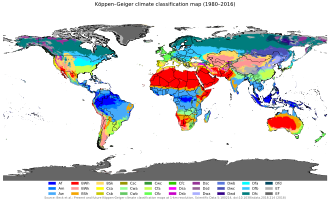
The Köppen classification depends on average monthly values of temperature and precipitation. The most commonly used form of the Köppen classification has five primary types labeled A through E. Specifically, the main types are A, tropical; B, dry; C, balmy mid-breadth; D, cold mid-latitude; and East, polar. The five primary classifications can be further divided into secondary classifications such as rain forest, monsoon, tropical savanna, humid subtropical, humid continental, oceanic climate, Mediterranean climate, steppe, subarctic climate, tundra, polar ice cap, and desert.
Pelting forests are characterized past loftier rainfall, with definitions setting minimum normal annual rainfall between i,750 and 2,000 mm (69 and 79 in).[101] A tropical savanna is a grassland biome located in semi-arid to semi-humid climate regions of subtropical and tropical latitudes, with rainfall between 750 and 1,270 mm (30 and l in) a year. They are widespread on Africa, and are too constitute in India, the northern parts of South America, Malaysia, and Australia.[102] The boiling subtropical climate zone is where winter rainfall (and sometimes snowfall) is associated with large storms that the westerlies steer from west to east. Most summer rainfall occurs during thunderstorms and from occasional tropical cyclones.[103] Humid subtropical climates lie on the e side continents, roughly betwixt latitudes xx° and twoscore° degrees from the equator.[104]
An oceanic (or maritime) climate is typically found along the w coasts at the middle latitudes of all the world's continents, adjoining cool oceans, too every bit southeastern Australia, and is accompanied past plentiful precipitation twelvemonth-round.[105] The Mediterranean climate regime resembles the climate of the lands in the Mediterranean Basin, parts of western Due north America, parts of western and southern Australia, in southwestern Southward Africa and in parts of key Republic of chile. The climate is characterized by hot, dry summers and absurd, wet winters.[106] A steppe is a dry grassland.[107] Subarctic climates are cold with continuous permafrost and trivial atmospheric precipitation.[108]
Upshot on agriculture [edit]

Rainfall estimates for southern Japan and the surrounding region from July twenty to 27, 2009.
Precipitation, especially rain, has a dramatic outcome on agriculture. All plants need at to the lowest degree some water to survive, therefore rain (beingness the virtually effective means of watering) is important to agriculture. While a regular rain design is ordinarily vital to healthy plants, too much or as well fiddling rainfall can exist harmful, even devastating to crops. Drought can impale crops and increase erosion,[109] while overly wet weather can cause harmful mucus growth.[110] Plants need varying amounts of rainfall to survive. For example, certain cacti crave minor amounts of water,[111] while tropical plants may need up to hundreds of inches of rain per year to survive.
In areas with wet and dry seasons, soil nutrients diminish and erosion increases during the wet flavour.[31] Animals accept adaptation and survival strategies for the wetter regime. The previous dry flavor leads to food shortages into the moisture flavor, as the crops have yet to mature.[112] Developing countries accept noted that their populations show seasonal weight fluctuations due to food shortages seen before the beginning harvest, which occurs tardily in the moisture season.[74]
Changes due to global warming [edit]
| | This section needs to exist updated. The reason given is: IPCC Sixth Assessment Report. (January 2022) |

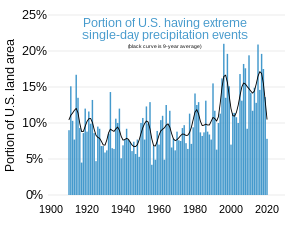
Extreme precipitation events have go more mutual in the U.Due south. over contempo decades.[113]
Increasing temperatures tend to increment evaporation which leads to more precipitation. Precipitation has by and large increased over land north of 30°N from 1900 to 2005 but has declined over the tropics since the 1970s. Globally there has been no statistically significant overall tendency in precipitation over the past century, although trends accept varied widely past region and over time. In 2018, a study assessing changes in atmospheric precipitation across spatial scales using a loftier-resolution global precipitation dataset of over 33+ years, ended that "While there are regional trends, at that place is no testify of increment in precipitation at the global scale in response to the observed global warming."[114]
Each region of the world is going to have changes in atmospheric precipitation due to their unique atmospheric condition. Eastern portions of Due north and South America, northern Europe, and northern and primal Asia take become wetter. The Sahel, the Mediterranean, southern Africa and parts of southern Asia take become drier. In that location has been an increase in the number of heavy precipitation events over many areas during the by century, likewise as an increase since the 1970s in the prevalence of droughts—especially in the tropics and subtropics. Changes in precipitation and evaporation over the oceans are suggested past the decreased salinity of mid- and high-latitude waters (implying more precipitation), along with increased salinity in lower latitudes (implying less atmospheric precipitation, more than evaporation, or both). Over the contiguous United States, total annual precipitation increased at an average rate of 6.1% per century since 1900, with the greatest increases inside the East North Central climate region (11.half dozen% per century) and the South (11.1%). Hawaii was the only region to show a subtract (−9.25%).[115]
Changes due to urban heat isle [edit]
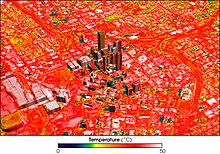
Paradigm of Atlanta, Georgia, showing temperature distribution, with hot areas appearing white
The urban rut isle warms cities 0.6 to 5.6 °C (1.one to x.one °F) in a higher place surrounding suburbs and rural areas. This actress heat leads to greater upwardly motion, which tin can induce additional shower and thunderstorm activity. Rainfall rates downwind of cities are increased between 48% and 116%. Partly as a event of this warming, monthly rainfall is about 28% greater between 32 to 64 kilometres (twenty to 40 mi) downwind of cities, compared with upwind.[116] Some cities induce a total precipitation increase of 51%.[117]
Forecasting [edit]
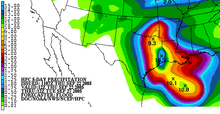
The Quantitative Atmospheric precipitation Forecast (abbreviated QPF) is the expected amount of liquid precipitation accumulated over a specified time period over a specified area.[118] A QPF will be specified when a measurable precipitation type reaching a minimum threshold is forecast for any hour during a QPF valid period. Precipitation forecasts tend to be bound by synoptic hours such every bit 0000, 0600, 1200 and 1800 GMT. Terrain is considered in QPFs by use of topography or based upon climatological precipitation patterns from observations with fine detail.[119] Starting in the mid to late 1990s, QPFs were used within hydrologic forecast models to simulate impact to rivers throughout the U.s..[120] Forecast models show significant sensitivity to humidity levels within the planetary boundary layer, or in the lowest levels of the atmosphere, which decreases with peak.[121] QPF can be generated on a quantitative, forecasting amounts, or a qualitative, forecasting the probability of a specific amount, basis.[122] Radar imagery forecasting techniques evidence college skill than model forecasts within half dozen to seven hours of the time of the radar image. The forecasts can exist verified through use of rain approximate measurements, weather radar estimates, or a combination of both. Diverse skill scores tin be adamant to measure the value of the rainfall forecast.[123]
See too [edit]
- Listing of meteorology topics
- Basic precipitation
- Bioprecipitation, the concept of rain-making leaner.
- Mango showers, pre-monsoon showers in the Indian states of Karnataka and Kerala that help in the ripening of mangoes.
- Sunshower, an unusual meteorological phenomenon in which pelting falls while the sun is shining.
- Wintry showers, an informal meteorological term for diverse mixtures of rain, freezing rain, sleet and snowfall.
References [edit]
- ^ Karger, D.N.; Schmatz, D.; Detttling, D.; Zimmermann, North.E. (2020). "igh resolution monthly atmospheric precipitation and temperature timeseries for the catamenia 2006-2100". Scientific Data. 7 (i): 248. arXiv:1912.06037. doi:10.1038/s41597-020-00587-y. PMC7378208. PMID 32703947.
- ^ "Precipitation". Glossary of Meteorology. American Meteorological Social club. 2009. Archived from the original on 2008-ten-09. Retrieved 2009-01-02 .
- ^ Scott Sistek (December 26, 2015). "What'southward the difference betwixt 'rain' and 'showers'?". KOMO-Telly. Retrieved January 18, 2016.
- ^ Adler, Robert F.; et al. (Dec 2003). "The Version-2 Global Precipitation Climatology Project (GPCP) Monthly Precipitation Assay (1979–Present)". Periodical of Hydrometeorology. 4 (6): 1147–1167. Bibcode:2003JHyMe...4.1147A. CiteSeerX10.ane.one.1018.6263. doi:10.1175/1525-7541(2003)004<1147:TVGPCP>2.0.CO;2.
- ^ a b Chowdhury's Guide to Planet World (2005). "The Water Cycle". WestEd. Archived from the original on 2011-12-26. Retrieved 2006-10-24 .
- ^ Seneviratne, Sonia I.; Zhang, Xuebin; Adnan, M.; Badi, Due west.; et al. (2021). "Chapter xi: Weather and climate extreme events in a changing climate" (PDF). IPCC AR6 WG1 2021 harvnb mistake: no target: CITEREFIPCC_AR6_WG12021 (aid) .
- ^ Graves, South. D. B.; McKay, C. P.; Griffith, C. A.; Ferri, F.; Fulchignoni, M. (2008-03-01). "Pelting and hail can achieve the surface of Titan". Planetary and Infinite Science. 56 (iii): 346–357. Bibcode:2008P&SS...56..346G. doi:ten.1016/j.pss.2007.eleven.001. ISSN 0032-0633.
- ^ "Cassini Sees Seasonal Rains Transform Titan'due south Surface". NASA Solar System Exploration . Retrieved 2020-12-15 .
- ^ "Changes in Titan'southward Lakes". NASA Solar Organization Exploration . Retrieved 2020-12-15 .
- ^ "Cassini Saw Rain Falling at Titan's N Pole". Universe Today. 2019-01-18. Retrieved 2020-12-15 .
- ^ Emmanouil Due north. Anagnostou (2004). "A convective/stratiform atmospheric precipitation classification algorithm for volume scanning conditions radar observations". Meteorological Applications. 11 (4): 291–300. Bibcode:2004MeApp..11..291A. doi:ten.1017/S1350482704001409.
- ^ A.J. Dore; M. Mousavi-Baygi; R.I. Smith; J. Hall; D. Fowler; T.Westward. Choularton (June 2006). "A model of annual orographic precipitation and acrid deposition and its application to Snowdonia". Atmospheric Environment. 40 (18): 3316–3326. Bibcode:2006AtmEn..40.3316D. doi:ten.1016/j.atmosenv.2006.01.043.
- ^ a b Robert Penrose Pearce (2002). Meteorology at the Millennium. Bookish Press. p. 66. ISBN978-0-12-548035-2.
- ^ Robert A. Houze, Jr. (1994). Cloud Dynamics. Academic Press. p. 348. ISBN978-0-08-050210-6.
- ^ Jan Jackson (2008). "All Well-nigh Mixed Winter Precipitation". National Weather Service. Retrieved 2009-02-07 .
- ^ Glossary of Meteorology (June 2000). "Dewpoint". American Meteorological Order. Archived from the original on 2011-07-05. Retrieved 2011-01-31 .
- ^ Khain, A. P.; BenMoshe, N.; Pokrovsky, A. (2008-06-01). "Factors Determining the Touch of Aerosols on Surface Precipitation from Clouds: An Try at Classification". Journal of the Atmospheric Sciences. 65 (6): 1721–1748. Bibcode:2008JAtS...65.1721K. doi:10.1175/2007jas2515.ane. ISSN 1520-0469.
- ^ FMI (2007). "Fog And Stratus - Meteorological Physical Background". Zentralanstalt für Meteorologie und Geodynamik. Retrieved 2009-02-07 .
- ^ Glossary of Meteorology (2009). "Adiabatic Process". American Meteorological Club. Archived from the original on 2007-x-17. Retrieved 2008-12-27 .
- ^ TE Technology, Inc (2009). "Peltier Common cold Plate". Retrieved 2008-12-27 .
- ^ Glossary of Meteorology (2009). "Radiational cooling". American Meteorological Gild. Archived from the original on 2011-05-12. Retrieved 2008-12-27 .
- ^ Robert Fovell (2004). "Approaches to saturation" (PDF). University of California in Los Angeles. Archived from the original (PDF) on 2009-02-25. Retrieved 2009-02-07 .
- ^ National Weather Service Role, Spokane, Washington (2009). "Virga and Dry Thunderstorms". Retrieved 2009-01-02 .
{{cite web}}: CS1 maint: multiple names: authors list (link) - ^ Bart van den Hurk & Eleanor Blyth (2008). "Global maps of Local Land-Atmosphere coupling" (PDF). KNMI. Archived from the original (PDF) on 2009-02-25. Retrieved 2009-01-02 .
- ^ H. Edward Reiley; Carroll L. Shry (2002). Introductory horticulture. Cengage Learning. p. 40. ISBN978-0-7668-1567-4.
- ^ National Weather Service JetStream (2008). "Air Masses". Archived from the original on 2008-12-24. Retrieved 2009-01-02 .
- ^ a b Michael Pidwirny (2008). "CHAPTER 8: Introduction to the Hydrosphere (e). Cloud Formation Processes". Physical Geography. Retrieved 2009-01-01 .
- ^ Benmoshe, N.; Pinsky, One thousand.; Pokrovsky, A.; Khain, A. (2012-03-27). "Turbulent effects on the microphysics and initiation of warm rain in deep convective clouds: 2-D simulations by a spectral mixed-phase microphysics cloud model". Journal of Geophysical Research: Atmospheres. 117 (D6): northward/a. Bibcode:2012JGRD..117.6220B. doi:10.1029/2011jd016603. ISSN 0148-0227.
- ^ Paul Sirvatka (2003). "Cloud Physics: Collision/Coalescence; The Bergeron Process". College of DuPage. Retrieved 2009-01-01 .
- ^ United States Geological Survey (2009). "Are raindrops tear shaped?". Us Department of the Interior. Archived from the original on 2012-06-18. Retrieved 2008-12-27 .
- ^ a b c d J. S. 0guntoyinbo and F. 0. Akintola (1983). "Rainstorm characteristics affecting h2o availability for agronomics" (PDF). IAHS Publication Number 140. Archived from the original (PDF) on 2009-02-05. Retrieved 2008-12-27 .
- ^ a b Robert A. Houze Jr (1997). "Stratiform Atmospheric precipitation in Regions of Convection: A Meteorological Paradox?". Bulletin of the American Meteorological Society. 78 (10): 2179–2196. Bibcode:1997BAMS...78.2179H. doi:x.1175/1520-0477(1997)078<2179:SPIROC>two.0.CO;2.
- ^ Norman W. Junker (2008). "An ingredients based methodology for forecasting precipitation associated with MCS's". Hydrometeorological Prediction Center. Retrieved 2009-02-07 .
- ^ a b c d eastward Alaska Air Flight Service Station (2007-04-ten). "SA-METAR". Federal Aviation Administration via the Net Wayback Machine. Archived from the original on 2008-05-01. Retrieved 2009-08-29 .
- ^ "Hail (glossary entry)". National Oceanic and Atmospheric Administration's National Atmospheric condition Service. Retrieved 2007-03-20 .
- ^ Weatherquestions.com. "What causes ice pellets (sleet)?". Retrieved 2007-12-08 .
- ^ Glossary of Meteorology (2009). "Hail". American Meteorological Guild. Archived from the original on 2010-07-25. Retrieved 2009-07-xv .
- ^ Ryan Jewell & Julian Brimelow (2004-08-17). "P9.5 Evaluation of an Alberta Hail Growth Model Using Astringent Hail Proximity Soundings in the United states of america" (PDF) . Retrieved 2009-07-fifteen .
- ^ National Severe Storms Laboratory (2007-04-23). "Amass hailstone". National Oceanic and Atmospheric Administration. Retrieved 2009-07-15 .
- ^ Julian C. Brimelow; Gerhard Westward. Reuter & Eugene R. Poolman (Oct 2002). "Modeling Maximum Hail Size in Alberta Thunderstorms". Weather and Forecasting. 17 (5): 1048–1062. Bibcode:2002WtFor..17.1048B. doi:x.1175/1520-0434(2002)017<1048:MMHSIA>2.0.CO;2.
- ^ Jacque Marshall (2000-04-10). "Hail Fact Sheet". University Corporation for Atmospheric Research. Archived from the original on 2009-10-15. Retrieved 2009-07-xv .
- ^ a b Yard. Klesius (2007). "The Mystery of Snowflakes". National Geographic. 211 (1): xx. ISSN 0027-9358.
- ^ William J. Broad (2007-03-20). "Giant Snowflakes as Large equally Frisbees? Could Be". New York Times . Retrieved 2009-07-12 .
- ^ Jennifer E. Lawson (2001). Hands-on Science: Low-cal, Concrete Scientific discipline (matter) - Affiliate 5: The Colors of Light. Portage & Chief Press. p. 39. ISBN978-1-894110-63-1 . Retrieved 2009-06-28 .
- ^ Kenneth Chiliad. Libbrecht (2006-09-xi). "Guide to Snowflakes". California Institute of Technology. Retrieved 2009-06-28 .
- ^ John Roach (2007-02-xiii). ""No 2 Snowflakes the Aforementioned" Likely True, Research Reveals". National Geographic. Retrieved 2009-07-14 .
- ^ Kenneth Libbrecht (Winter 2004–2005). "Snowflake Science" (PDF). American Educator. Archived from the original (PDF) on 2008-11-28. Retrieved 2009-07-14 .
- ^ Glossary of Meteorology (June 2000). "Diamond Dust". American Meteorological Society. Archived from the original on 2009-04-03. Retrieved 2010-01-21 .
- ^ Kenneth Grand. Libbrecht (2001). "Morphogenesis on Ice: The Physics of Snowfall Crystals" (PDF). Engineering & Science. California Found of Engineering science (one): 12. Archived from the original (PDF) on 2010-06-25. Retrieved 2010-01-21 .
- ^ Unsworth, Yard H; Wilshaw, J C (September 1989). "Wet, occult and dry out deposition of pollutants on forests". Agricultural and Woods Meteorology. 47 (ii–4): 221–238. Bibcode:1989AgFM...47..221U. doi:x.1016/0168-1923(89)90097-10. Retrieved 26 March 2021.
- ^ a b B. Geerts (2002). "Convective and stratiform rainfall in the tropics". Academy of Wyoming. Retrieved 2007-11-27 .
- ^ David Roth (2006). "Unified Surface Analysis Manual" (PDF). Hydrometeorological Prediction Center. Retrieved 2006-10-22 .
- ^ Jim Lochner (1998). "Ask an Astrophysicist". NASA Goddard Space Flight Center. Retrieved 2009-01-16 .
- ^ Glossary of Meteorology (2009). "Graupel". American Meteorological Society. Archived from the original on 2008-03-08. Retrieved 2009-01-02 .
- ^ Toby N. Carlson (1991). Mid-latitude Weather condition Systems. Routledge. p. 216. ISBN978-0-04-551115-0 . Retrieved 2009-02-07 .
- ^ Diana Leone (2002). "Rain supreme". Honolulu Star-Message . Retrieved 2008-03-19 .
- ^ Western Regional Climate Center (2002). "Climate of Hawaii". Retrieved 2008-03-nineteen .
- ^ Paul Eastward. Lydolph (1985). The Climate of the World. Rowman & Littlefield. p. 333. ISBN978-0-86598-119-5 . Retrieved 2009-01-02 .
- ^ Michael A. Mares (1999). Encyclopedia of Deserts. University of Oklahoma Press. p. 252. ISBN978-0-8061-3146-seven . Retrieved 2009-01-02 .
- ^ Adam Ganson (2003). "Geology of Death Valley". Indiana Academy. Retrieved 2009-02-07 .
- ^ Joan Von Ahn; Joe Sienkiewicz; Greggory McFadden (April 2005). "Hurricane Force Extratropical Cyclones Observed Using QuikSCAT Nigh Existent Fourth dimension Winds". Mariners Weather Log. Voluntary Observing Ship Program. 49 (1). Retrieved 2009-07-07 .
- ^ Owen Hertzman (1988). "Three-Dimensional Kinematics of Rainbands in Midlatitude Cyclones Abstruse". PhD thesis. University of Washington. Bibcode:1988PhDT.......110H.
- ^ Yuh-Lang Lin (2007). Mesoscale Dynamics. Cambridge Academy Printing. p. 405. ISBN978-0-521-80875-0 . Retrieved 2009-07-07 .
- ^ B. Geerts (1998). "Lake Effect Snowfall". Academy of Wyoming. Retrieved 2008-12-24 .
- ^ Greg Byrd (1998-06-03). "Lake Effect Snowfall". University Corporation for Atmospheric Research. Archived from the original on 2009-06-17. Retrieved 2009-07-12 .
- ^ Karl West. Birkeland & Cary J. Mock (1996). "Atmospheric Circulation Patterns Associated With Heavy Snow Events, Bridger Bowl, Montana, USA" (PDF). Mountain Research and Development. sixteen (three): 281–286. doi:10.2307/3673951. JSTOR 3673951. Archived from the original (PDF) on 2009-01-fifteen.
- ^ Glossary of Meteorology (2009). "Rainy flavour". American Meteorological Society. Archived from the original on 2009-02-fifteen. Retrieved 2008-12-27 .
- ^ Costa Rica Guide (2005). "When to Travel to Costa Rica". ToucanGuides. Retrieved 2008-12-27 .
- ^ Michael Pidwirny (2008). "Affiliate 9: Introduction to the Biosphere". PhysicalGeography.net. Retrieved 2008-12-27 .
- ^ Elisabeth Chiliad. Benders-Hyde (2003). "World Climates". Blueish Planet Biomes. Retrieved 2008-12-27 .
- ^ Mei Zheng (2000). "The sources and characteristics of atmospheric particulates during the moisture and dry seasons in Hong Kong". Dissertations and Chief's Theses (Campus Access). University of Rhode Isle: i–378. Bibcode:2000PhDT........13Z. Retrieved 2008-12-27 .
- ^ S. I. Efe; F. Due east. Ogban; M. J. Horsfall; Eastward. East. Akporhonor (2005). "Seasonal Variations of Physico-chemic Characteristics in Water Resource Quality in Western Niger Delta Region, Nigeria" (PDF). Journal of Applied Scientific Environmental Direction. 9 (1): 191–195. ISSN 1119-8362. Retrieved 2008-12-27 .
- ^ C. D. Haynes; G. G. Ridpath; K. A. J. Williams (1991). Monsoonal Australia. Taylor & Francis. p. ninety. ISBN978-ninety-6191-638-3 . Retrieved 2008-12-27 .
- ^ a b Marti J. Van Liere, Eric-Alain D. Ategbo, Jan Hoorweg, Adel P. Den Hartog, and Joseph G. A. J. Hautvast (1994). "The significance of socio-economic characteristics for adult seasonal torso-weight fluctuations: a written report in north-western Republic of benin". British Journal of Nutrition. 72 (iii): 479–488. doi:x.1079/BJN19940049. PMID 7947661.
{{cite journal}}: CS1 maint: multiple names: authors list (link) - ^ Chris Landsea (2007). "Field of study: D3 - Why exercise tropical cyclones' winds rotate counter-clockwise (clockwise) in the Northern (Southern) Hemisphere?". National Hurricane Center. Retrieved 2009-01-02 .
- ^ Climate Prediction Heart (2005). "2005 Tropical Eastern North Pacific Hurricane Outlook". National Oceanic and Atmospheric Administration. Retrieved 2006-05-02 .
- ^ Jack Williams (2005-05-17). "Background: California'southward tropical storms". United states Today . Retrieved 2009-02-07 .
- ^ National Climatic Data Center (2005-08-09). "Global Measured Extremes of Temperature and Precipitation". National Oceanic and Atmospheric Assistants. Archived from the original on 2012-05-25. Retrieved 2007-01-18 .
- ^ Dr. Owen E. Thompson (1996). Hadley Circulation Cell. Archived 2009-03-05 at the Wayback Car Channel Video Productions. Retrieved on 2007-02-11.
- ^ ThinkQuest team 26634 (1999). The Formation of Deserts. Archived 2012-10-17 at the Wayback Automobile Oracle ThinkQuest Education Foundation. Retrieved on 2009-02-16.
- ^ "USGS 220427159300201 1047.0 Mt. Waialeale Rain Gage nr Lihue, Kauai, Hullo". USGS Existent-fourth dimension rainfall data at Waiʻaleʻale Raingauge. Retrieved 2008-12-11 .
- ^ U.s.a. Today. Mt. Baker snowfall tape sticks. Retrieved on 2008-02-29.
- ^ National Conditions Service Office, Northern Indiana (2009). "eight Inch Non-Recording Standard Rain Gauge". Retrieved 2009-01-02 .
- ^ Chris Lehmann (2009). "10/00". Central Belittling Laboratory. Archived from the original on 2010-06-15. Retrieved 2009-01-02 .
- ^ National Weather Service Office Binghamton, New York (2009). "Rainguage Information". Retrieved 2009-01-02 .
- ^ National Weather Service (2009). "Glossary: W". Retrieved 2009-01-01 .
- ^ Discovery School (2009). "Build Your Own Weather Station". Discovery Education. Archived from the original on 2008-08-28. Retrieved 2009-01-02 .
- ^ "Community Collaborative Pelting, Hail & Snow Network Main Page". Colorado Climate Center. 2009. Retrieved 2009-01-02 .
- ^ The Globe Plan (2009). "Global Learning and Observations to Benefit the Environment Plan". Archived from the original on 2006-08-19. Retrieved 2009-01-02 .
- ^ National Weather Service (2009). "NOAA'due south National Conditions Service Main Page". Retrieved 2009-01-01 .
- ^ Glossary of Meteorology (2009). "Hydrometeor". American Meteorological Society. Retrieved 2009-07-16 .
- ^ National Aeronautics and Space Assistants (2012). "NASA and JAXA'southward GPM Mission Takes Rain Measurements Global". Retrieved 2014-01-21 .
- ^ C. Kidd; G.J. Huffman (2011). "Global Atmospheric precipitation Measurement". Meteorological Applications. 18 (3): 334–353. Bibcode:2011MeApp..eighteen..334K. doi:10.1002/met.284.
- ^ F.J. Tapiador; et al. (2012). "Global Precipitation Measurement Methods, Datasets and Applications". Atmospheric Research. 104–105: 70–97. Bibcode:2013AtmRe.119..131W. doi:10.1016/j.atmosres.2011.ten.012.
- ^ International Precipitation Working Grouping. "Global Precipitation Datasets". Retrieved 2014-01-21 .
- ^ Glossary of Meteorology (June 2000). "Return period". American Meteorological Order. Archived from the original on 2006-10-20. Retrieved 2009-01-02 .
- ^ Glossary of Meteorology (June 2000). "Rainfall intensity return period". American Meteorological Society. Archived from the original on 2011-06-06. Retrieved 2009-01-02 .
- ^ Boulder Surface area Sustainability Information Network (2005). "What is a 100 twelvemonth alluvion?". Bedrock Community Network. Retrieved 2009-01-02 .
- ^ Angeline G. Pendergrass; Reto Knutti (Oct nineteen, 2018). "The Uneven Nature of Daily Precipitation and Its Change". Geophysical Research Letters. 45 (21): 11, 980–11, 988. Bibcode:2018GeoRL..4511980P. doi:10.1029/2018GL080298.
Half of annual atmospheric precipitation falls in the wettest 12 days each yr in the median across observing stations worldwide.
- ^ Peel, M. C. and Finlayson, B. L. and McMahon, T. A. (2007). "Updated world map of the Köppen-Geiger climate classification". Hydrol. Earth Syst. Sci. 11 (v): 1633–1644. Bibcode:2007HESS...11.1633P. doi:10.5194/hess-11-1633-2007. ISSN 1027-5606.
{{cite periodical}}: CS1 maint: multiple names: authors list (link) (directly: Last Revised Paper) - ^ Susan Woodward (1997-10-29). "Tropical Broadleaf Evergreen Woods: The Rainforest". Radford University. Archived from the original on 2008-02-25. Retrieved 2008-03-fourteen .
- ^ Susan Woodward (2005-02-02). "Tropical Savannas". Radford University. Archived from the original on 2008-02-25. Retrieved 2008-03-xvi .
- ^ "Humid subtropical climate". Encyclopædia Britannica. Encyclopædia Britannica Online. 2008. Retrieved 2008-05-xiv .
- ^ Michael Ritter (2008-12-24). "Boiling Subtropical Climate". University of Wisconsin–Stevens Point. Archived from the original on 2008-10-fourteen. Retrieved 2008-03-16 .
- ^ Lauren Springer Ogden (2008). Found-Driven Design. Timber Printing. p. 78. ISBN978-0-88192-877-8.
- ^ Michael Ritter (2008-12-24). "Mediterranean or Dry Summer Subtropical Climate". Academy of Wisconsin–Stevens Betoken. Archived from the original on 2009-08-05. Retrieved 2009-07-17 .
- ^ Brynn Schaffner & Kenneth Robinson (2003-06-06). "Steppe Climate". West Tisbury Elementary School. Archived from the original on 2008-04-22. Retrieved 2008-04-15 .
- ^ Michael Ritter (2008-12-24). "Subarctic Climate". University of Wisconsin–Stevens Point. Archived from the original on 2008-05-25. Retrieved 2008-04-16 .
- ^ Bureau of Meteorology (2010). "Living With Drought". Republic of Australia. Archived from the original on 2007-02-18. Retrieved 2010-01-15 .
- ^ Robert Burns (2007-06-06). "Texas Ingather and Atmospheric condition". Texas A&Chiliad University. Archived from the original on 2010-06-20. Retrieved 2010-01-fifteen .
- ^ James D. Mauseth (2006-07-07). "Mauseth Research: Cacti". University of Texas. Retrieved 2010-01-15 .
- ^ A. Roberto Frisancho (1993). Homo Adaptation and Accommodation. University of Michigan Printing, pp. 388. ISBN 978-0-472-09511-7. Retrieved on 2008-12-27.
- ^ Data from "Climate change Indicators: Heavy Precipitation". EPA.gov. U.South. Environmental Protection Agency. Apr 2021. Archived from the original on five February 2022.
- ^ Nguyen, Phu; Thorstensen, Andrea; Sorooshian, Soroosh; Hsu, Kuolin; Aghakouchak, Amir; Ashouri, Hamed; Tran, Hoang; Braithwaite, Dan (2018-04-01). "Global Precipitation Trends beyond Spatial Scales Using Satellite Observations". Message of the American Meteorological Society. 99 (four): 689–697. Bibcode:2018BAMS...99..689N. doi:10.1175/BAMS-D-17-0065.1. ISSN 0003-0007. OSTI 1541806.
- ^ Climate Change Division (2008-12-17). "Precipitation and Tempest Changes". United States Environmental Protection Agency. Retrieved 2009-07-17 .
- ^ Dale Fuchs (2005-06-28). "Kingdom of spain goes hi-tech to beat drought". The Guardian. London. Retrieved 2007-08-02 .
- ^ Goddard Space Flight Centre (2002-06-18). "NASA Satellite Confirms Urban Rut Islands Increase Rainfall Around Cities". National Aeronautics and Space Administration. Archived from the original on March xvi, 2010. Retrieved 2009-07-17 .
- ^ Jack S. Bushong (1999). "Quantitative Precipitation Forecast: Its Generation and Verification at the Southeast River Forecast Centre" (PDF). University of Georgia. Archived from the original (PDF) on 2009-02-05. Retrieved 2008-12-31 .
- ^ Daniel Weygand (2008). "Optimizing Output From QPF Helper" (PDF). National Weather Service Western Region. Archived from the original (PDF) on 2009-02-05. Retrieved 2008-12-31 .
- ^ Noreen O. Schwein (2009). "Optimization of quantitative precipitation forecast time horizons used in river forecasts". American Meteorological Society. Archived from the original on 2011-06-09. Retrieved 2008-12-31 .
- ^ Christian Keil; Andreas Röpnack; George C. Craig & Ulrich Schumann (2008-12-31). "Sensitivity of quantitative atmospheric precipitation forecast to height dependent changes in humidity". Geophysical Research Letters. 35 (ix): L09812. Bibcode:2008GeoRL..3509812K. doi:10.1029/2008GL033657.
- ^ P. Reggiani & A. H. Weerts (2007). "Probabilistic Quantitative Precipitation Forecast for Flood Prediction: An Application". Periodical of Hydrometeorology. ix (1): 76–95. Bibcode:2008JHyMe...9...76R. doi:10.1175/2007JHM858.1.
- ^ Charles Lin (2005). "Quantitative Precipitation Forecast (QPF) from Weather Prediction Models and Radar Nowcasts, and Atmospheric Hydrological Modelling for Flood Simulation" (PDF). Achieving Technological Innovation in Overflowing Forecasting Project. Archived from the original (PDF) on 2009-02-05. Retrieved 2009-01-01 .
External links [edit]
- Current map of the global precipitation forecast for the adjacent 3 hours
- Study local rainfall within the United States at this site (CoCoRaHS)
- Report local rainfall related to tropical cyclones worldwide at this site
- Global Atmospheric precipitation Climatology Heart GPCC
Source: https://en.wikipedia.org/wiki/Precipitation
0 Response to "Here Again the Rain Is Falling Put Under Closer"
Post a Comment